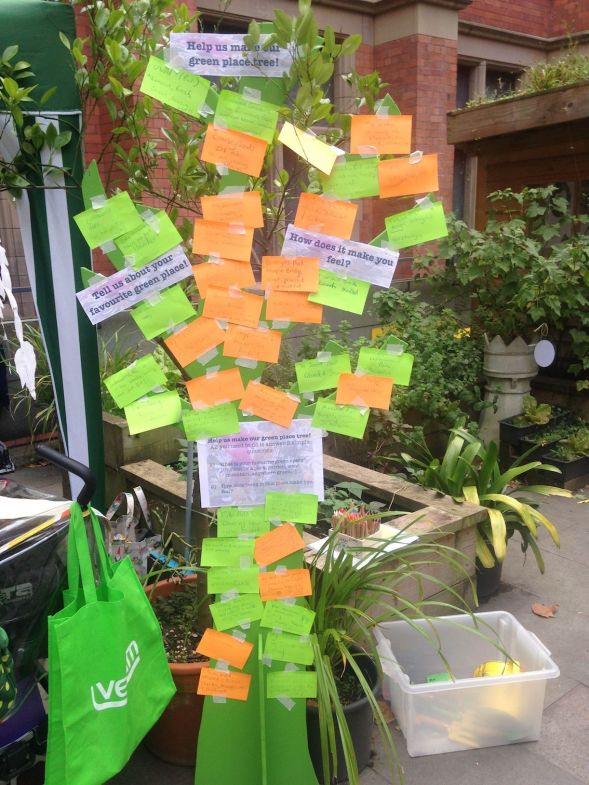
“Where is your favourite green place? How does it make you feel?” Brandishing post-it notes and crayons, these were the two questions I asked people who were trying to enjoy a quiet Sunday afternoon in August. I was participating in the festival of nature at the Manchester Museum on Oxford Road and competing (or at least attempting to) with the more exciting RSPB bug catching activity and a messy play area run by Hulme community garden. Still by the end of the day I had 42 brightly coloured post-it notes stuck onto my wooden tree (borrowed from the Manchester Museum) and they told an interesting story.
The three main categories (which overlap and are very open to debate) were natural landscapes (this included coastline, woods and rainforests– so predominately what people might consider wild or natural) with 33% of the notes, parks, including nature reserves, with 28% and their own garden, or in one case their father’s garden with 19%. Historic landscapes (such as Tatton Park, Bolton Abbey and Greenwich Park) came in fourth with 11% of the places mentioned. However, if this was combined with the parks result, of which many are historically significant, designed historic landscapes would have made 40% of the total.
Other individual mentions were made for the Fallowfield loop which is a cycling and walking route on a disused railway line, the Eden Project and a local community garden (by the daughter of the woman running the messy play). What is clear is that the spread of locations goes from the very domestic (my back garden) to the exotic and global (rainforests). From conversations and the notes made reasons for choosing a place came from a bank of memories – whether of a place that was significant in their past or from watching their child play in it earlier that day.
19 respondents (so almost half) used words like calm, tranquil, relaxed, peaceful, relaxing to describe how it made them feel. Other common words were ‘happy’ and ‘fun’. Although these feelings are perhaps unsurprising, I was struck by the resonances with nineteenth century ideas regarding the role of asylum gardens for patients with mental illness. As I noted here, the two main emotions which were hoped to be evoked by the landscape and time spent within it were ‘tranquility’ and ‘cheerfulness’. So there is a longer history to be explored regarding emotions and gardens.
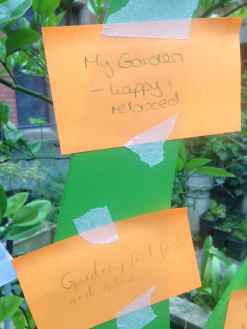
The four children who filled in notes of their own generally associated their favourite places with more energetic emotions such as ‘creatively excited’ and ‘thrilled’. There were also connections made across generations. One woman described her father’s back garden in the Caribbean as her favourite place to be while a couple of adults described feelings of ‘pride’ and ‘gratitude’ associated with places where they watched their children play.
Some of the emotions associated with the spaces related to activities such as play, walking and cycling. Animals also got a mention with dogs, deer and ducks as well as wildlife in general getting mentions as part of the positive reasons for liking particular spaces.


There were also larger narratives at play varying from landscapes that made people feel in ‘awe of creation’, ‘feeling wonder’ and an ‘immense, sense of connection with the earth’. That connection with nature was cited several times as well as the effect of ‘feeling myself’.
Another interesting emotion was feeling ‘useful’ which related to time spent in the garden. And the feeling of nostalgia or memories of home which were also evoked by particular spaces.
There were also mentions of urban green spaces which made you feel like you were somewhere else, even within a busy built up setting. That, and the feelings of ‘fresh air’, ‘space’ and ‘openness’, were certainly sentiments associated with green space that the Victorians and Edwardians would have recognized.

Image: Victoria Park, Hackney, London
In 1890, Lord Meath argued that, ‘in addition to large suburban parks, the working man, and much more the working woman and her children, need numerous small playgrounds and open spaces within easy reach of their homes, where of a summer evening after his work, the man may rest and smoke his pipe, and where, during the day, the woman may snatch half-an-hour’s enjoyment of peaceful repose away from the turmoil and care of home, amid flowers and leaves and the sound of falling waters. Even if she cannot get away herself to visit the gardens or playgrounds, at least she can at all events send her little ones, under the charge of the eldest child, with the feeling that they are in the pure air, beneath the brightest sun of Heave, getting health and strength…’ From Lord Meath, ‘Lungs For Our Great Cities’, The New Review, 2:12 (1890) p.433

Image: Edward V fishing pool in Altrincham, Cheshire. My nearest green/blue space.
Many of the ideas here are similar to those described above. Although a historical analysis based on the emotions themselves could unpick some of the terms used by our contemporary post-it note writers and those of the past. In the future I hope to take a more detailed approach to considering the role of emotions, memory, heritage and green space in well-being. So this is just a starter for ten on the connections between place and emotion and how a historical perspective could add a new layer. Let me also ask you – what is your favourite green place and how does it make you feel?
For more reading on gardens and health see:
http://www.kingsfund.org.uk/sites/files/kf/field/field_publication_file/Gardens_and_health.pdf
With many thanks to Manchester Museum for having me and lending me their tree along with the post-it notes and crayons.

 Dr Clare Hickman
Leave a comment